
Insurance
Services
Our Insurance blog posts
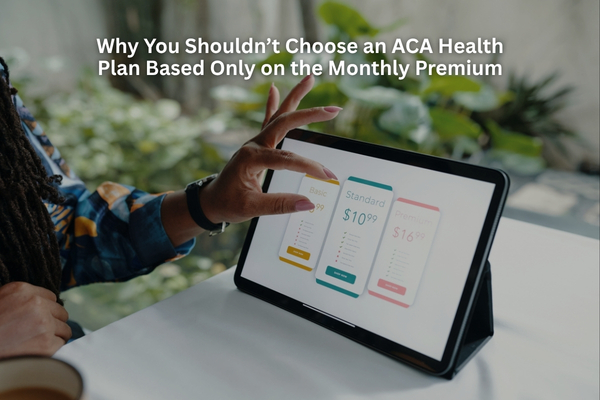
Why You Shouldn’t Choose an ACA Health Plan Based Only on the Monthly Premium
When it’s time to select a health insurance plan through the Marketplace, many people make the same mistake:
They choose the plan with the lowest monthly premium.
At first glance, this seems logical. A lower monthly payment means saving money, right?
Not necessarily.
In health insurance, the monthly premium is only one piece of the financial picture. Choosing a plan based solely on premium can lead to:
Unexpected medical expenses
High out-of-pocket costs
Financial stress during emergencies
Limited provider access
Higher total annual costs
In this evergreen guide, we will explain why the monthly premium should not be your only deciding factor and how to evaluate the true cost of an ACA health plan.
What Is the Monthly Premium?
The monthly premium is the fixed amount you pay each month to keep your health insurance active.
You pay it whether you use medical services or not.
However, the premium does not tell you:
How much you’ll pay if you’re hospitalized
How expensive a surgery will be
What your prescription costs will look like
How much you must pay before insurance starts covering major services
This is why focusing only on premium can be misleading.
The True Cost of an ACA Plan
To understand the real financial impact of a health plan, you must evaluate the full structure.
An ACA plan includes:
Monthly premium
Deductible
Copayments
Coinsurance
Out-of-pocket maximum
The balance between these elements determines whether the plan is financially manageable in both routine and emergency scenarios.
The Deductible: The Overlooked Cost Factor
The deductible is the amount you must pay out of pocket before your insurance begins covering many services.
For example, if your deductible is $7,000, you must pay that amount before most major benefits apply.
Many Bronze plans offer low premiums but high deductibles.
That means:
Low monthly cost
High financial exposure when care is needed
A low premium does not equal low overall cost.

Copays and Coinsurance: The Costs That Add Up
In addition to the deductible, plans include other cost-sharing mechanisms.
Copayment (Copay)
A fixed amount you pay for services such as:
Doctor visits
Specialist consultations
Prescription medications
Urgent care visits
Coinsurance
A percentage of the cost you pay after meeting your deductible.
For example, if your plan covers 80%, you pay 20%.
In the case of hospitalization or ongoing treatment, coinsurance can become significant.
The Out-of-Pocket Maximum: Your Financial Safety Net
The out-of-pocket maximum is the annual limit on what you must pay for covered services.
Once you reach this amount, your insurance covers 100% of eligible expenses for the rest of the year.
This figure is critical.
A plan with a low premium but a very high out-of-pocket maximum may expose you to substantial financial risk.
When Does a Low Premium Make Sense?
A lower-premium plan may be appropriate if:
You are young and generally healthy
You rarely visit the doctor
You have a strong emergency savings fund
You can comfortably afford a high deductible
Even then, the risk must be carefully evaluated.
When Is a Higher Premium Worth It?
A plan with a higher premium may be beneficial if:
You have ongoing medical conditions
You take regular prescriptions
You frequently see specialists
You prefer predictable healthcare expenses
You want lower out-of-pocket exposure
Paying more monthly can reduce uncertainty and financial stress later.
Provider Networks Matter
Not all ACA plans offer the same provider networks.
Choosing based only on premium may result in:
Losing access to your current doctor
Being out-of-network at your preferred hospital
Facing unexpected out-of-network charges
Network verification is as important as cost evaluation.
The Real Cost in a Hospitalization Scenario
Consider two plans:
Plan A
Low premium
High deductible
High out-of-pocket maximum
Plan B
Moderate premium
Lower deductible
Lower out-of-pocket maximum
If you experience a hospitalization, Plan B may ultimately cost less overall—even though the monthly premium is higher.
The premium is only the starting point of the calculation.

The Short-Term Savings Trap
Many individuals focus on saving money this month.
But health insurance protects against large, unpredictable expenses—not routine small ones.
When evaluating plans, consider:
Minimal healthcare usage scenario
Moderate healthcare usage scenario
Major medical event scenario
Only then can you estimate realistic total annual cost.
How to Properly Evaluate an ACA Plan
Before enrolling, analyze:
Monthly premium
Deductible
Copay structure
Coinsurance percentage
Out-of-pocket maximum
Provider network
Prescription drug formulary
Premium tax credit (if applicable)
The right balance determines value—not just the lowest monthly number.
The Role of Premium Tax Credits
Many individuals qualify for financial assistance that reduces the monthly premium.
This can significantly change your decision.
For example:
A subsidized Silver plan may cost nearly the same as a Bronze plan—but provide better cost-sharing and coverage.
Always compare final premium after subsidies.
A Smarter Question to Ask
Instead of asking:
“What is the cheapest plan?”
Ask:
“Which plan provides the best protection within my budget?”
That shift in mindset makes a major financial difference.
Conclusion: Health Insurance Is Protection, Not Just a Bill
Choosing an ACA plan based only on the monthly premium can lead to costly mistakes.
The premium matters—but it is not the full story.
A complete evaluation includes:
Financial risk exposure
Expected medical usage
Deductible affordability
Out-of-pocket maximum limits
Network accessibility
The best plan is not always the cheapest.
It is the one that balances affordability with meaningful protection.
Making an informed decision today can prevent financial stress tomorrow.

We offer a wide range of insurance services, backed by the best companies on the market, designed to cover all your protection needs.

Available Policies
Health Insurance
Obamacare
Medicare
Private Insurance
Corporate insurance packages
Life Insurance
Individual
Group
Indexed Policies
Indexed policies are life insurance that grow in value according to the market.
If the market goes up, your money grows.
If the market goes down, you don't lose because there is cero risk.
It is a safe way to invest and protect your money.
Medicaid and Social Security Benefits Advisory
Supplemental Coverage
Dental
Vision
Hearing
Accidents
Cancer
Disability
Out-of-Pocket Insurance
An out-of-pocket insurance is a policy designed to protect you from the highest medical costs. This insurance pays medical expenses that exceed a certain limit, ensuring that you do not have to pay more than a specific amount. This way, it helps you manage unexpected and high healthcare costs, providing you with financial peace of mind.
Internation Health Insurance
We offer insurance in the USA, Mexico, and worldwide.
Our Commercial Partners




Call Us Now
469-405-7054


